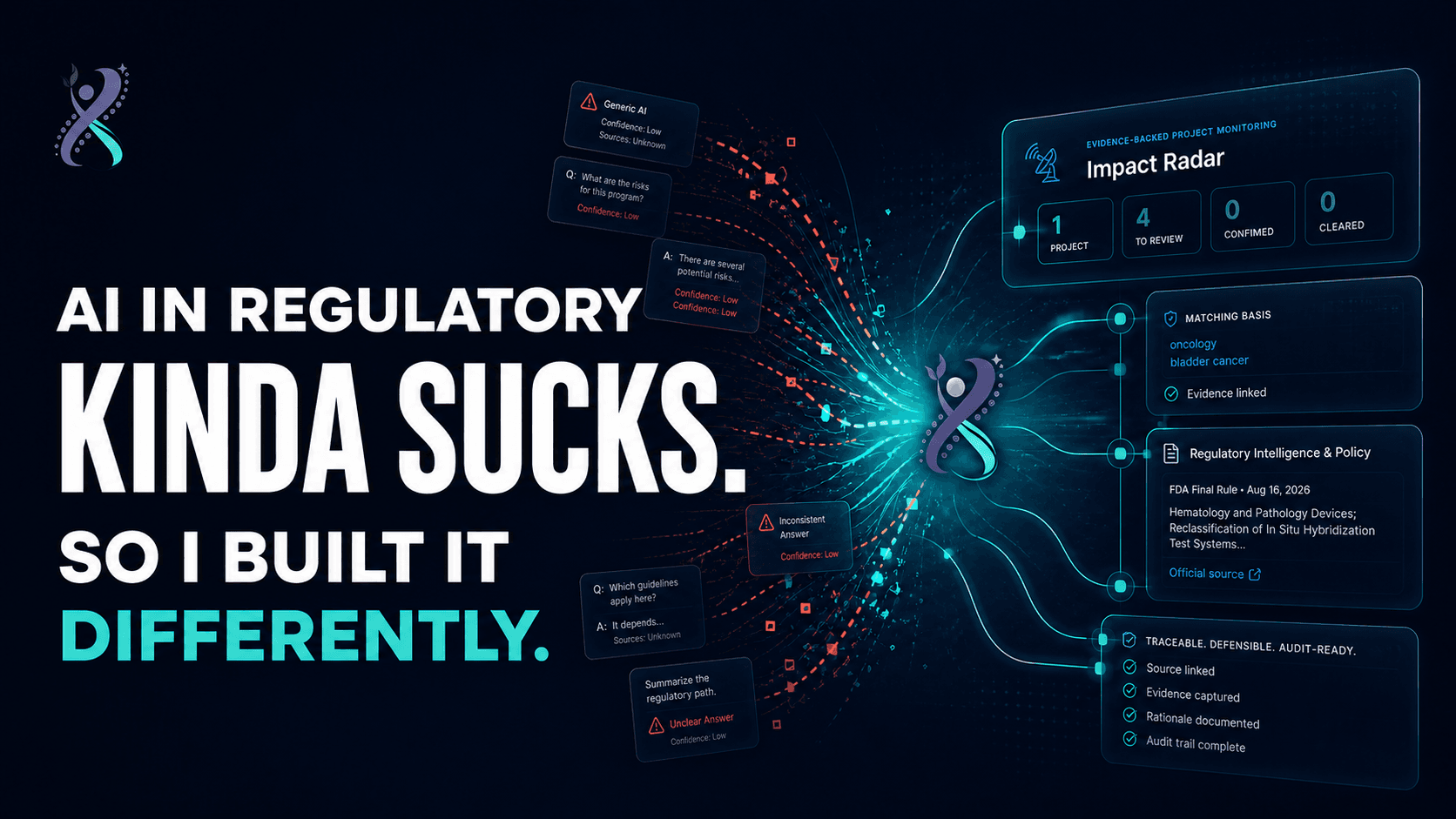
Let me say the part the AI industry usually avoids:
AI by itself can be bad. Sometimes impressively bad, like horrifying.
Ask the same question on Monday and Friday and you can get two different answers. Start a new session and the reasoning changes. Move to another platform, another model, or another subscription tier and the answer changes again, often with the same confident tone.
That is mildly irritating when you are asking for restaurant ideas.
It is a serious problem when the question is:
- What will FDA challenge in this development plan?
- What changes between an FDA and EMA strategy?
- Which gaps could delay an IND, BLA, NDA, or MAA?
- How should we prepare for a health authority meeting?
- Which new regulatory update actually affects an active program?
- Can we turn this analysis into an executive presentation without losing the evidence behind it?
People are tired of hearing that AI is going to change everything. I am too. So I am not asking anyone to be impressed by another chatbot.
I am asking a different question:
What has to be built around AI before a serious regulatory team should rely on it?
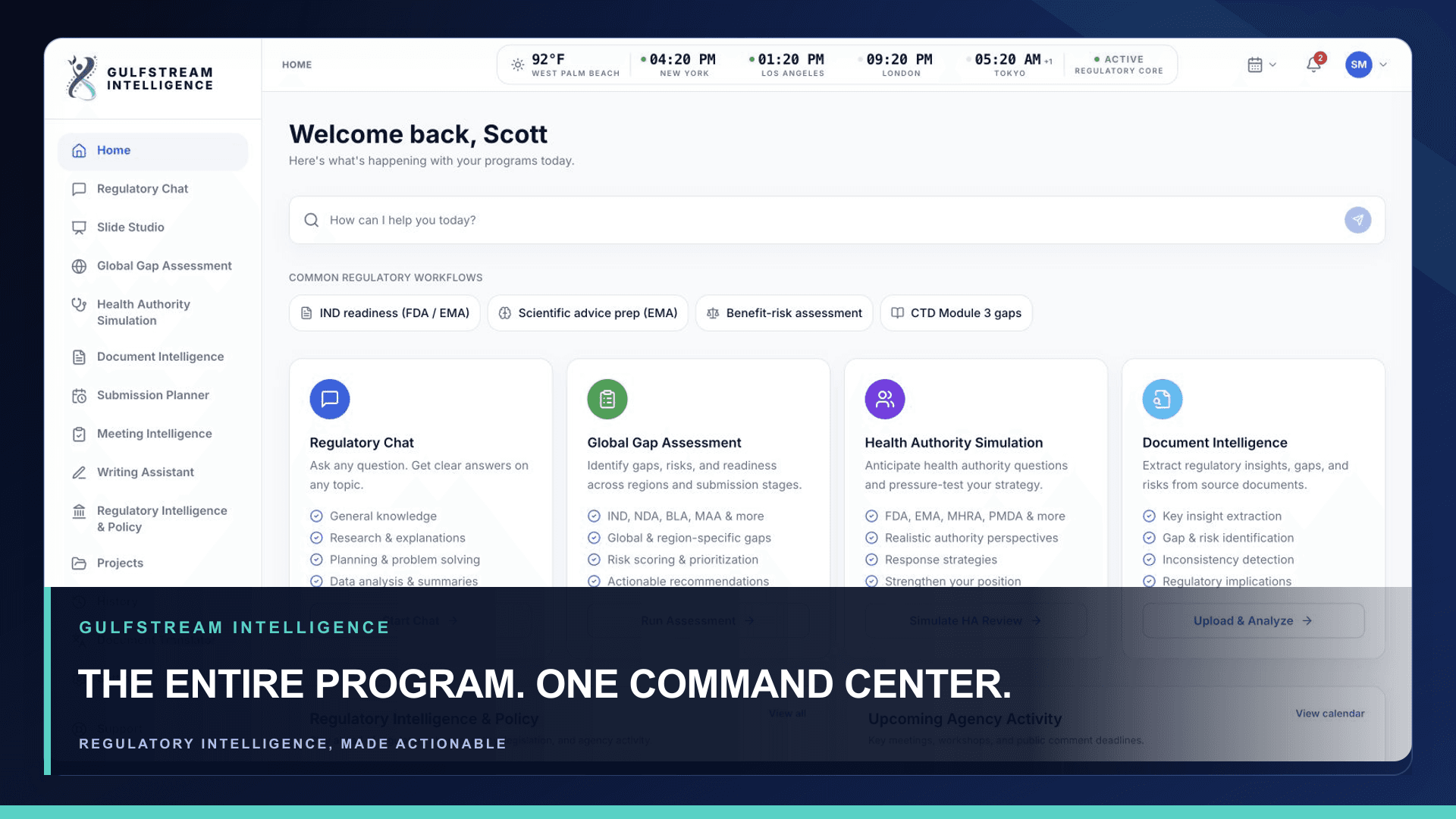
Gulfstream Intelligence was built as one connected command center, not a collection of disconnected AI prompts.
A model is not a system
General-purpose AI is designed to be flexible. That is its strength, and it is also the problem.
It does not automatically know which program is active, which documents are approved, which health authorities matter, which source hierarchy your team follows, what was decided in the last meeting, or whether a confident answer is actually supported by the evidence in front of it.
It also does not reliably carry your operating rules from one session to the next unless the product around the model deliberately rebuilds that context.
In regulatory work, a clever answer is not enough. The answer needs a basis. The basis needs to be visible. The context needs to persist. And the accountable professional needs to remain in control.
That is the foundation I used to build Gulfstream Intelligence.
The real difference is the infrastructure around the model
Gulfstream is not one master prompt sitting on top of a general chatbot. It is a group of purpose-built regulatory engines, each with a defined job, workflow, and set of operating rules.
Every time a user makes a request, the platform rebuilds the relevant instruction stack. Depending on the task, that can include:
- The operating mode
- The selected program and project profile
- The relevant health authorities
- Approved or uploaded documents
- Designated regulatory sources
- The current page and workflow state
- Task-specific rules, boundaries, and required output structure
The model is not expected to remember what we meant last Tuesday. The system supplies the rules and context again.
That eliminates a large class of avoidable drift. It constrains the model before the answer is generated, instead of hoping a user remembers how to write the perfect prompt every time.
And to be clear: no serious developer should promise that any generative AI system can never hallucinate. The responsible goal is to reduce the opportunity for unsupported claims, show what an answer is grounded in, clearly identify when evidence was not found, and keep human review at the decision point.
That is much more useful than pretending the risk does not exist.
Program Mode: less freedom, more control
Gulfstream has a deliberate separation between General Mode and Program Mode.
General Mode is there for broader research, drafting, and exploration.
Program Mode is different. It is designed as a controlled-source operating environment. It can bring together project-specific context, approved program documents, selected health authorities, designated regulatory information, citations, and persistent program memory.
Every answer can state whether it is grounded, what authorities were searched, and which sources support it. If the system does not find a match, it should say that instead of dressing up general knowledge as project evidence.
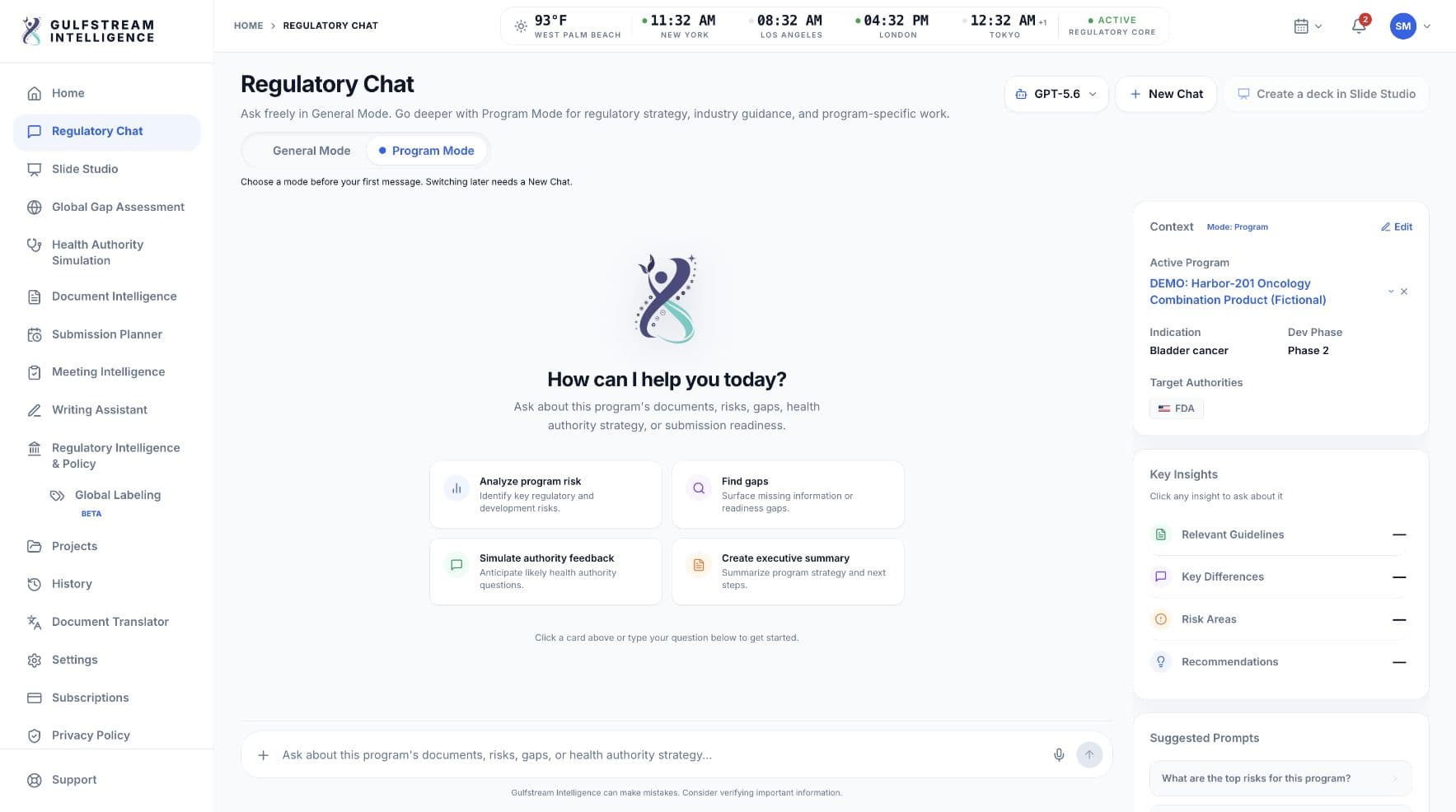
Program Mode separates controlled program work from open-ended AI use and carries the result into the Regulatory Core or the next workflow.
This is a small interface choice with a big governance consequence: exploratory AI and controlled regulatory work should not look identical.
Regulatory intelligence should answer “what changes for us?”
Regulatory teams already have access to more news, guidance, notices, meetings, legislation, and policy updates than they can reasonably process.
Another feed is not the answer.
Gulfstream's Regulatory Intelligence & Policy engine monitors activity across FDA, EMA, ICH, MHRA, PMDA, Health Canada, legislation, agency meetings, and other regulatory sources. But the important part is what happens next.
Impact Radar connects an update to the attributes of an active project and shows the matching basis. It separates the general regulatory significance of a source from its possible impact on a specific program.
And it does not silently turn a match into a regulatory conclusion.
Every potential impact remains Needs review until a person starts a review, confirms the impact, or dismisses the match. The official source stays attached. The matching terms are visible. Human judgment stays exactly where it belongs.
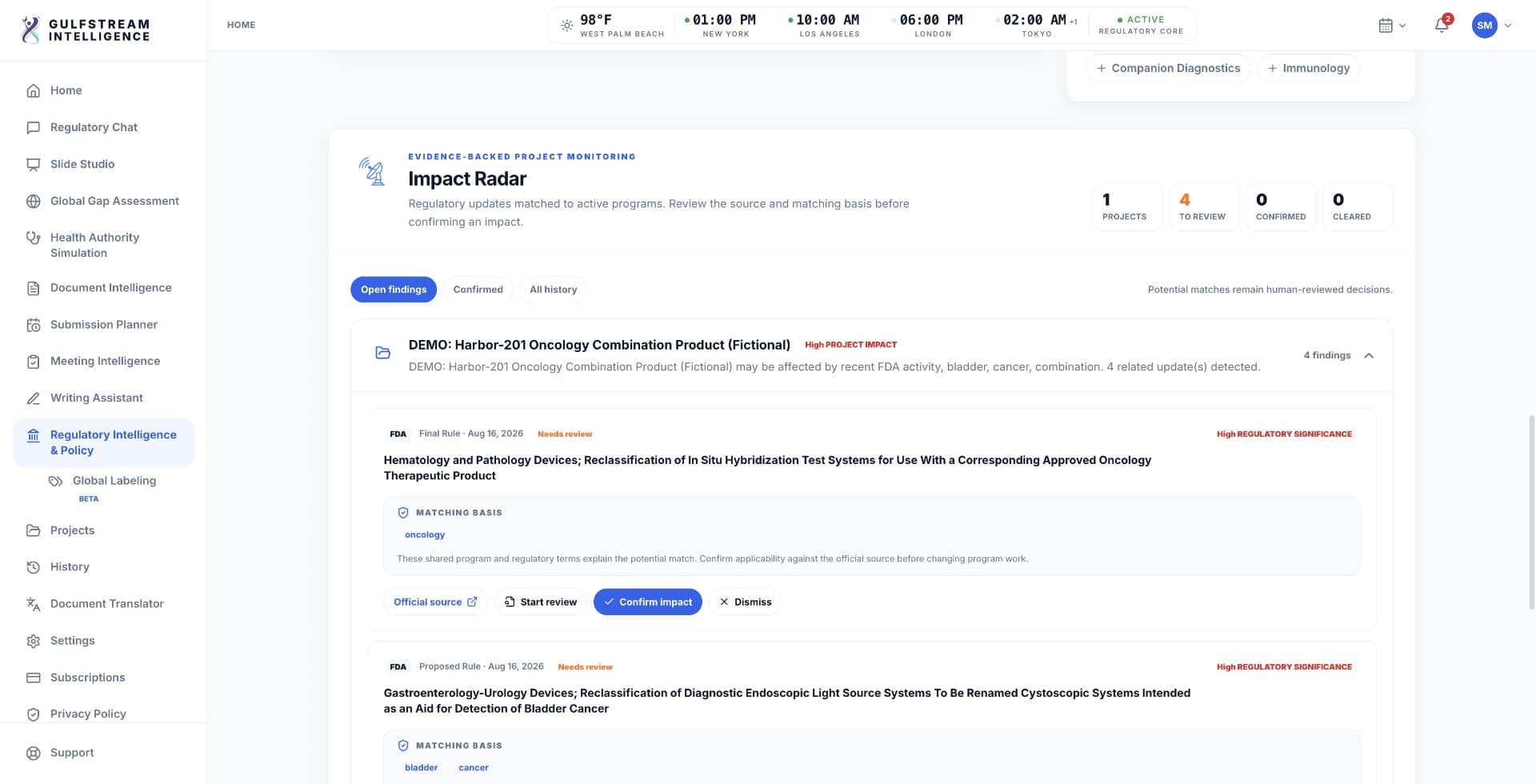
Impact Radar shows the official source, matching basis, project-level significance, and the human review actions. The project shown is fictional.
That is the pattern across Gulfstream: AI narrows the field, organizes the evidence, and makes the next action obvious. It does not appoint itself the regulatory decision-maker.
Health authority preparation should pressure-test strategy, not improvise theater
Health Authority Simulation is another example.
A general chatbot can role-play an FDA reviewer. That may be interesting. But a serious simulation needs more than a persona. It needs the project, development phase, submission type, known evidence, open gaps, target authority, and the regulatory strategy being tested.
Gulfstream organizes likely questions and concerns by domain, identifies critical items, produces a feedback summary, supports meeting-brief development, and helps the team build response guidance. The purpose is not to predict the future with certainty. It is to expose weak logic before the real meeting does.
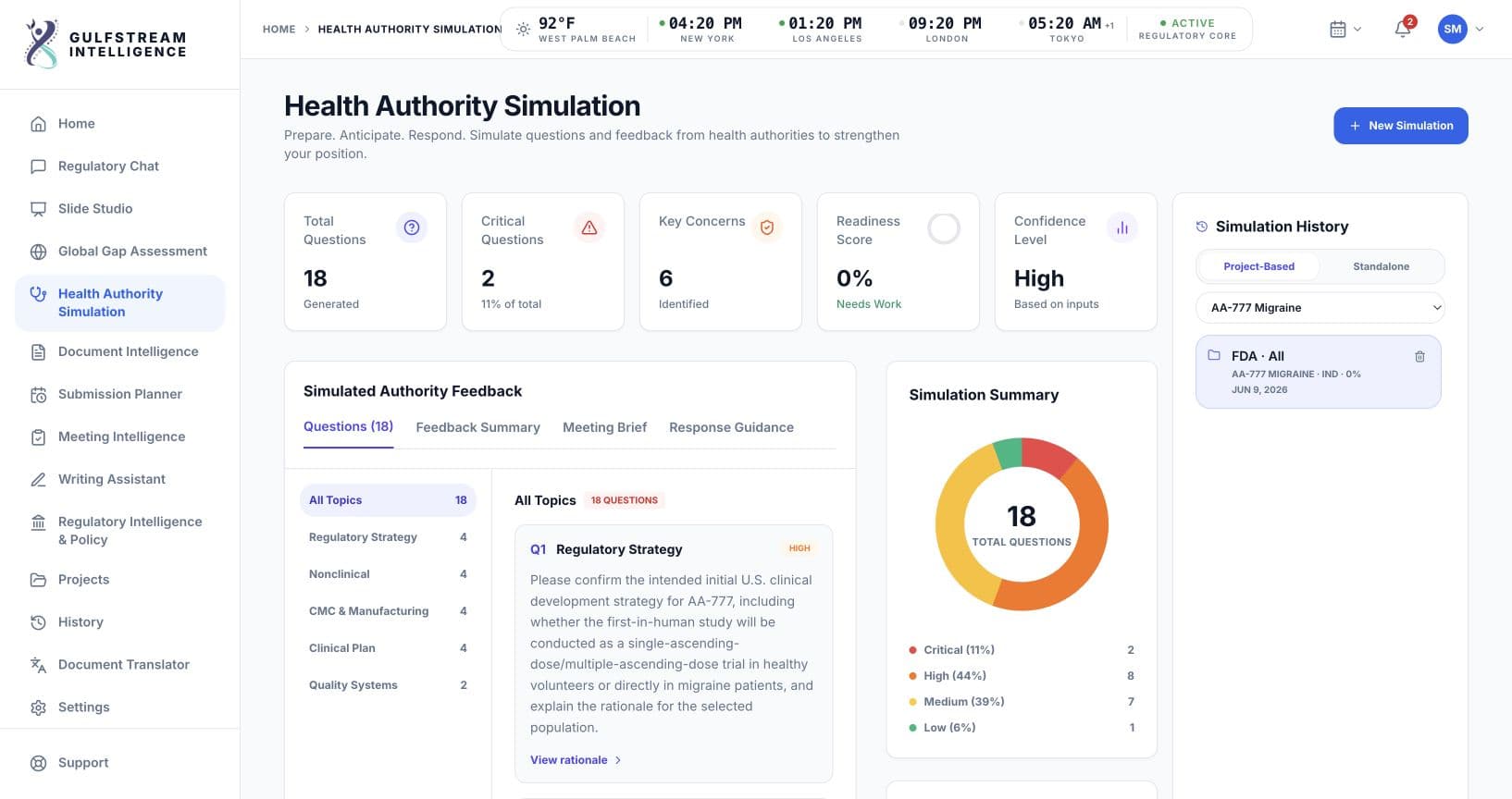
Health Authority Simulation structures likely questions, critical concerns, meeting preparation, and response planning around the program context.
The same operating principle powers Global Gap Assessment: evaluate readiness across regions, rank gaps by severity, connect them to supporting evidence, and turn findings into prioritized action.
Evidence has to survive the workflow
One of the biggest failures in AI products is that provenance disappears as the work moves forward.
The answer may begin with a source, but after it becomes a summary, an email, a slide, or a new-market adaptation, nobody can easily see where the claim came from.
Gulfstream was built so the evidence can travel with the work.
In Document Intelligence, the platform extracts insights, risks, gaps, inconsistencies, and regulatory implications from source material. In Global Labeling, controlled product information can move through a structured lifecycle covering the CCDS, regional labels, mapping, change and impact, evidence, review, history, artwork, and regional 3D concepts.
The source label is reusable evidence, not automatic approval in a new market. That distinction is explicitly built into the workflow.
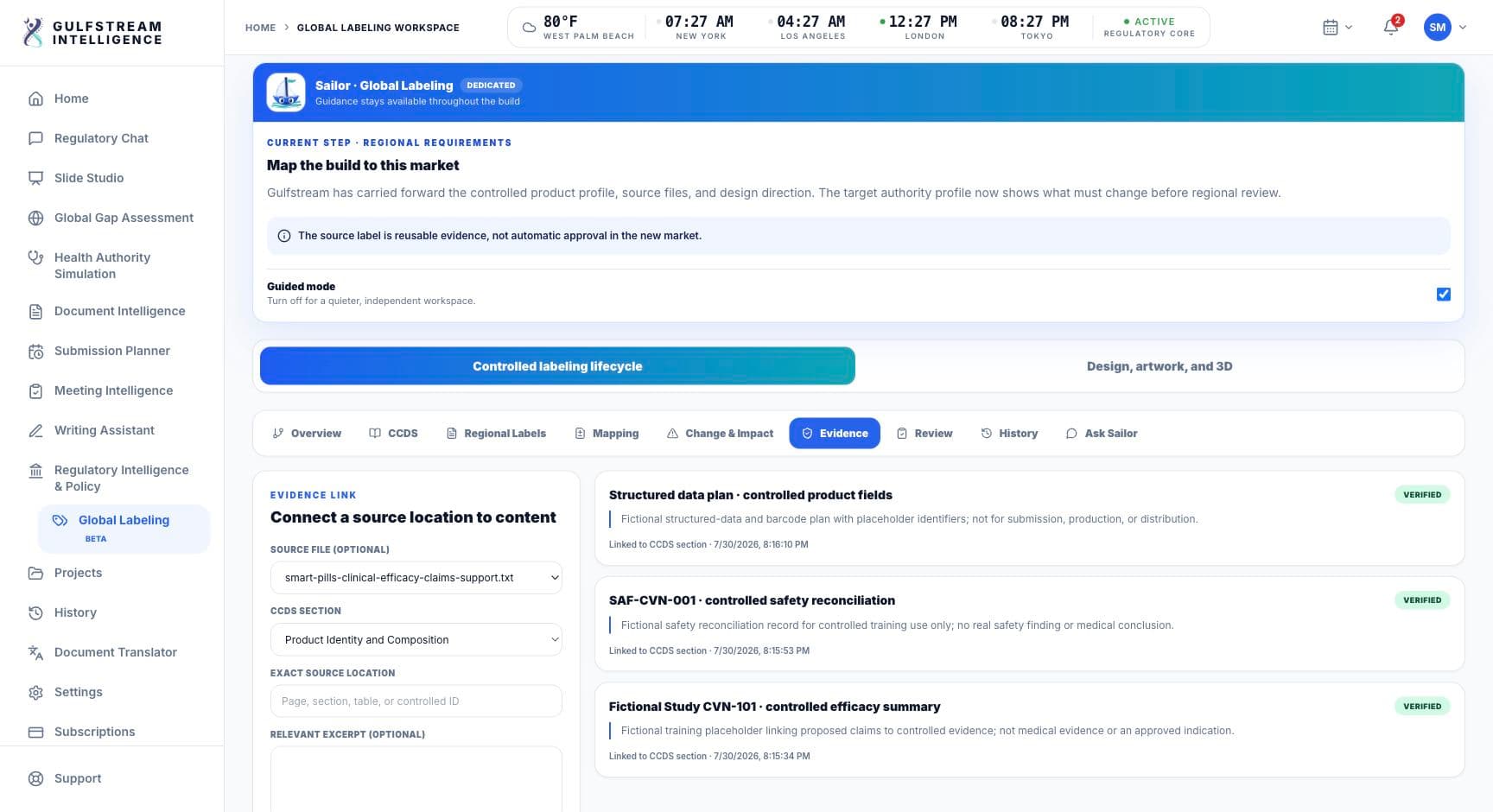
Global Labeling links controlled claims to source locations and keeps verification and review visible. The Smart Pills example is fictional.
This is what “purpose-built” should mean. Not a pharma-colored chat window. A workflow that understands what must remain controlled, what can be generated, what must be reviewed, and what needs a history.
Even the slides need guardrails
Anyone who has asked a general AI tool to create a presentation has seen the problem. The deck may look polished until you inspect the content, the citations, the hierarchy, the formatting, or the editable file.
In a regulatory environment, a beautiful unsupported slide is not a deliverable. It is a new risk.
Slide Studio starts with the regulatory work already completed inside Gulfstream. It turns a Regulatory Chat, document analysis, submission plan, or meeting output into an evidence-grounded narrative. The user can apply a company design, edit the slide content, preserve source context, reorder the story, export an editable PowerPoint, or publish into the Microsoft 365 workflow.
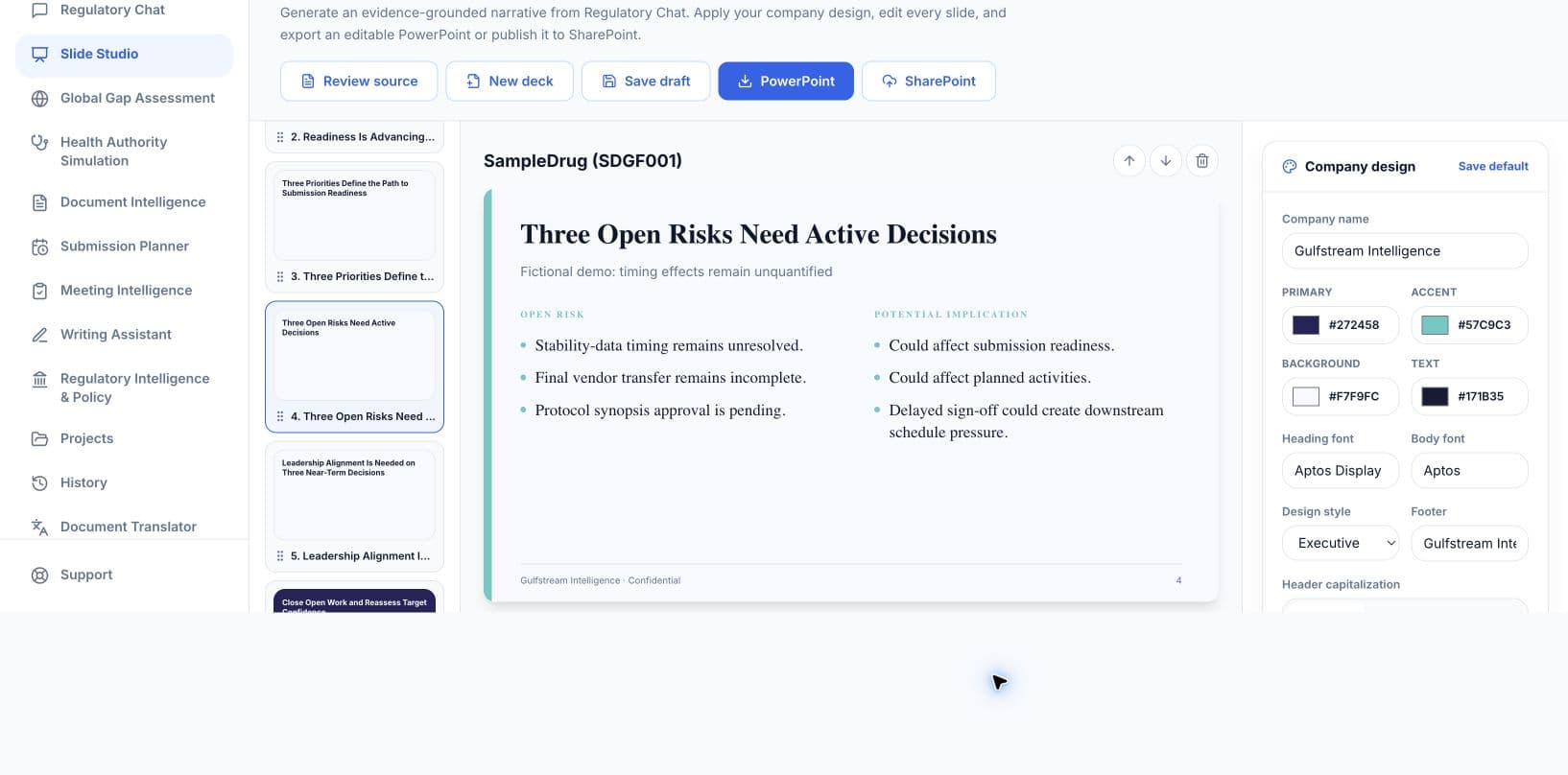
Slide Studio keeps the narrative editable and connected to its source while supporting company design, PowerPoint, and SharePoint workflows.
That connection matters. The analysis, the decision, and the presentation should not become three unrelated versions of the truth.
The platform is larger than chat
Today, Gulfstream connects the work across:
- Regulatory Chat with General and Program Mode
- Global Gap Assessment
- Health Authority Simulation
- Document Intelligence
- Submission Planner for IND, NDA, BLA, MAA, CTD structures, milestones, dates, and dependencies
- Regulatory Intelligence & Policy with daily briefs, events, watchlists, Sailor, and Impact Radar
- Global Labeling with controlled evidence, regional adaptation, review, artwork, and 3D concepts
- Slide Studio for editable, evidence-grounded presentations
- Meeting Intelligence for recaps, decisions, actions, owners, and dates
- Writing Assistant for audience-specific regulatory and professional communication
- Document Translator with preservation of identifiers, agency names, and critical terminology
- Project Workspaces, History, and the Regulatory Core that keep the context connected
The Regulatory Core is the connective tissue. The modules read from it, contribute back to it, and keep the team from starting over every time they open a new tool.
That is the infrastructure I wanted when I was looking at the current wave of AI products: not twelve isolated features, but one operating picture for the program.
Security is more than SOC 2 alphabet soup
SOC 2 matters. Independent controls and evidence matter. But a badge is not the architecture, and it does not make an unsupported answer reliable.
Trust starts earlier:
- Customer data is not used to train the AI models.
- Data is encrypted in transit and at rest.
- Access is controlled and intentionally limited.
- Production access follows least-privilege principles.
- Human review and intended-use boundaries are part of the product itself.
At this stage of Gulfstream, I am the developer-founder and the only human with direct access to the production database. That is deliberate. It creates a very short accountability chain: I built the system, I am responsible for the architecture, and broad internal access is not treated as a default convenience.
That statement does not replace audits, testing, or formal controls. It explains the foundation they should be built on.
Good AI is often less “AI” than people expect
The more serious the work, the less the model should improvise.
Good regulatory AI should have boundaries. It should know which sources it is allowed to use. It should distinguish a potential match from a confirmed impact. It should preserve the evidence. It should reveal when grounding is missing. It should remember the program without inventing the program. And it should hand the final decision back to a qualified professional.
The model will continue to change. New versions will be faster, cheaper, and more capable.
But the operating standard around the model should not drift every time the industry releases something new.
That's exactly what I built Gulfstream Intelligence to do.
It is not AI for the sake of saying we use AI, not in the least.
It is a regulatory infrastructure layer that uses AI where AI is strong, constrains it where it is weak, and connects the result to the work that has to happen next.
So yes: using AI in regulatory can kinda suck.
Using it without purpose, context, evidence, memory, or control definitely does.
When those things are engineered into every request, every workflow, and every handoff, the same technology becomes genuinely useful.
That is the difference.
That is Gulfstream Intelligence.
Gulfstream Intelligence is a decision-support platform. It does not replace qualified regulatory judgment, establish regulatory policy, provide legal advice, or guarantee regulatory outcomes. Demonstration programs and product examples shown in this article are fictional.
Official sources
This resource is general educational information, not legal or regulatory advice. Requirements vary by product, authority, development stage, and current agency expectations. Qualified personnel should verify the applicable regulations and guidance before relying on it.